Rabu, 17 Juli 2013

Senator Lindsey Graham Suggest Sochi Olympic Boycott

Politico reports that US Senator Lindsey Graham (R-SC) has floated the idea of the US boycotting the 2014 Sochi Olympics as a statement of protest over Russian
Sen. Lindsey Graham said on Wednesday that the United States should weigh boycotting the 2014 Winter Olympics over Russia’s conduct around the world, including the country’s handling of NSA leaker Edward Snowden.

“Yes, I would consider it. I know athletes would be heartbroken,” the South Carolina Republican told NBC News’s Kelly O’Donnell in an interview broadcast on “Today.” “I don’t know if putting the Olympics on the table is the right answer, but I do know this: What we’re doing is not working.”

Graham said the move would put pressure on Russian President Vladimir Putin to change his ways.

“I love the Olympics, but I hate what the Russian government is doing throughout the world,” Graham told NBC News. “If they give asylum to a person who I believe has committed treason against the United States, that’s taking it to a new level.”

Graham also pointed to the Olympics in Nazi Germany as an example of when governments need to take a stand.
Hard to see this getting traction, but serves as a reminder that sports and large-scale geopolitics are never far apart.

Jumat, 12 Juli 2013

The Proposed Reforms from Transparency International Unimplemented by FIFA

Below you can find the recommendations made by Transparency International in 2011in its report Safe Hands: Building Integrity and Transparency at FIFA which I have identified as having not been adopted by FIFA in its reform process. These of course comprise part of the reform evaluation wich I recent discussed at Play the Game and to which FIFA responded to here.

Overall, I identified 28 statements in the form of recommendations in the Safe Hands report. Of those 28, FIFA failed to even partially implement 23. Those 23 are listed below, to aid in discussion and (ideally) debate. Questions worth thinking about include: Which ones are most important? Which ones are secondary? Which may be off the mark? Comments welcomed either here or via email.

In coming posts I'll do the same with respect to the unimplemented recommendations from the pre-reform commissioned paper of Mark Pieth and those found in the first report of the FIFA IGC.
  • FIFA should set up a committee of insiders and outsiders to review its code of ethics for the organization and its officials (be they elected or appointed, paid or unpaid) and employees.
  • Clear conflict of interest policy with a transparent interests register for leaders (published, for example, on the FIFA website) 
  • Disclosure of income of leading staff members as well as remuneration of members of the Executive Committee and other key bodies
  • Guidelines for giving and receiving gifts at all levels of football governing bodies.
  • Special guidelines for high-risk areas
  • FIFA should establish a help desk to answer questions from anyone to whom the code applies about handling difficult situations (for example, how to deal with a specific invitation, or which gifts might be appropriate in a specific situation), providing anonymity if required.
  • A maximum of two terms for positions including the Executive Committee and the Finance Committee
  • Transparent and competitive elections and appointment processes
  • Presence of non-executive (i.e. external) directors to the Executive Committee, Finance Committee and all major bodies
  • The general secretary and the directors should be appointed for a set time-limit (for example five years with reappointment).
  • We recommend that the multi-stakeholder group assesses the current standards
  • Setting up a remuneration committee to decide on the remuneration packages, including bonuses, pensions, etc. of all senior FIFA officials. It should be guided by clear criteria, which should be decided by a larger decision-making body. Membership should include both internal FIFA and external (independent) representatives, the chair being one of the independent members. A report by the remuneration committee should be published in FIFA’s annual report. (These recommendations parallel good practice in the business world.)
  • Publishing the audit reports from the local as well as from central independent auditors to give an account of the financial control system.
  • Establishing an “Audit from below” i.e. publishing the use of funds in detail per confederation and member federation, so that interested parties can see whether the payments made match the services and/or goods/infrastructure received.
  • [T]here is a need for additional transparency and more detailed public reporting. Public reporting cannot be limited to financial information; it must also disclose the criteria for, and processes behind, decisions made at the top.
  • There should also be formalized and consistent reporting on anti-corruption activities integrated into already established reporting processes (e.g., accounting).
  • FIFA needs clear published guidelines for the initiation and execution of investigations.
  • Whistleblower protection rules and the appointment of an independent ombudsman Each suspicion has to be investigated professionally, by a body independent of the Executive Committee
  • Each suspicion has to be investigated professionally, by a body independent of the Executive Committee
  • Each breach of rules/code of ethics must have consequences. If a list of offences and sanctions is published, no board decisions will be seen as arbitrary.
  • Any breach of criminal law must be referred to the appropriate authorities for prosecution
  • FIFA, as well as its confederations and national federations using money allocated by FIFA, should report annually on anti-corruption policies and their implementation, as well as on any allegations and the actions taken.
  • The organizing committees for all events under the direct control of FIFA, especially the FIFA World Cup but also FIFA Women’s and Youth tournaments, should be obliged to use Integrity Pacts4 (anticorruption contracts) for any construction projects and to publish reports under the new Sector Supplement Events of the Global Reporting Initiative, which provides guidelines for Corporate Social Responsibility.

Minggu, 07 Juli 2013

Characteristics of a "Financially" Virtuous Woman

Do you (or someone you know) want to be a "Financially" Virtuous Woman? I DO!
   
I've seen many articles about the characteristics of the Proverbs “Virtuous Woman.”  But, I haven't really found too many about how to be a "Financially" Virtuous Woman.  I not only strive to be a Proverbs Virtuous Woman, but I also strive to be a "Financially" Virtuous Woman as well.    
 
So, here are my interpretations of the Characteristics of a "Financially" Virtuous Woman based on Proverbs 31:10-31 (KJV). 
 
She knows her value.
“10 Who can find a virtuous woman? for her price is far above rubies.”
 
Like an authentic and priceless gem, she knows her value and doesn't settle. When a woman knows her value to an organization that she is working for, she will not settle for low pay or abusive working conditions. She knows that she is worth more and deserves better.
  
She is trusted by her spouse (or God).
“11 The heart of her husband doth safely trust in her, so that he shall have no need of spoil. 12 She will do him good and not evil all the days of her life.”
 
She protects the financial security of her family and is fiscally responsible. She only has the best intentions and helps to reach her family's financial goals. Therefore, her spouse “safely” trusts her and in her personal financial management. If she is single, she is trusted by God.
 
She will work to provide for her household.
“13 She seeketh wool, and flax, and worketh willingly with her hands. 14 She is like the merchants' ships; she bringeth her food from afar. 15  She riseth also while it is yet night, and giveth meat to her household, and a portion to her maidens.”
 
Whether it is going to work or getting another job, she will do whatever it takes to financially provide for her family, when and if necessary.
 
She is a homeowner or owns real estate.
“16 She considereth a field, and buyeth it: with the fruit of her hands she planteth a vineyard.”
 
She owns or has owned real estate as a homeowner or as an investor. This not only shows that she is financially self-sufficient, but it also shows that she is responsible with her finances and credit to be able to qualify and afford real estate.
    
She is fit.
“17 She girdeth her loins with strength, and strengtheneth her arms.”
 
She is not only physically fit with strength to handle the demands and responsibilities placed upon her; she financially fit with the strength of personal financial knowledge to handle or assist with the financial demands and responsibilities of the household.
 
She is disciplined.
“18  She perceiveth that her merchandise is good: her candle goeth not out by night. 19 She layeth her hands to the spindle, and her hands hold the distaff.”
 
Even when she doesn't feel like it or want to do it, she is disciplined enough to do what is necessary to do whatever needs to be done for the betterment of herself and her family.

She volunteers to help others.
“20 She stretcheth out her hand to the poor; yea, she reacheth forth her hands to the needy.”
 
Whether it is at church, for a non-profit organization, or in her community; she gives her money, resources and time to help others who are less fortunate than she is. She understands that the Power of Prosperity lies in her Gift of Giving.
 
She is proactive and saves.
“21 She is not afraid of the snow for her household: for all her household are clothed with scarlet. 22 She maketh herself coverings of tapestry; her clothing is silk and purple.”
 
She plans for what is to come as well as prepares for what could happen. She saves for emergencies, establishes a budget, and ensures her household has what is needed at all times.

She respects her spouse.
“23 Her husband is known in the gates, when he sitteth among the elders of the land.”
 
She creates a strong financial foundation with her spouse for their family.  She may not agree with her spouse all of time but she respects him and his financial decisions.  Because of her power of influence, her spouse is respected within the community. 
   
She is an entrepreneur.
“24 She maketh fine linen, and selleth it; and delivereth girdles unto the merchant.”
  
She is a business owner or has an entrepreneurial mind and spirit. She is able to create a product or service that creates an income source to provide for her family.
 
She is respectful and respected.
“25 Strength and honour are her clothing; and she shall rejoice in time to come. 26 She openeth her mouth with wisdom; and in her tongue is the law of kindness.”
 
She respects others and commands respect from others. She helps to educate those around her about finances with honesty and love. This is why people appreciate her advice.                                                                      
 
She is NOT lazy.
“27 She looketh well to the ways of her household, and eateth not the bread of idleness.”
 
She understand when it is time to rest and when it is time to get up and make it happen.  She is not lazy and idle with her thinking or her ways.
  
She is loved and respected by her family.
“28 Her children arise up, and call her blessed; her husband also, and he praiseth her.”
 
She is loved and adored by her children and her husband and they appreciate everything she does to protect, defend, support and take care of the family. They know that the love she has for her family is her driving force to do what she does, only the way she can do it for them.
  
She is competitive.
“29 Many daughters have done virtuously, but thou excellest them all.”
 
She is driven to do her best. She may not be competing with others. Rather, she is usually competing against herself with a goal to be financially better off than she was a month or year before. She reads books and seeks information and assistance to improve her personal financial management skills.

She is humble & loves the Lord.
“30 Favour is deceitful, and beauty is vain: but a woman that feareth the Lord, she shall be praised.”
 
Although she is beautiful and has nice things, she remains humble and does not boast. She also has a relationship with God and understands that all that she has is a gift from God. She tithes because she believes that "You can't beat God's Giving!"

She is a Role Model.
“31 Give her of the fruit of her hands; and let her own works praise her in the gates.”
 
She is admired by others by the way she carries herself in public and at home. She doesn't take this responsibility lightly and understands her impact on her family and her community. Her financial success and freedom are her fruit she bears and shares.


How many characteristics do you possess? ;-)
  
Financially True,

Jumat, 05 Juli 2013

FIFA Responds to My Reform Report Card

FIFA has graciously provided a response to my initial evaluation of the FIFA Reform effort which was published at Play the Game last month. Below is the FIFA response in full. I note that FIFA officials are not among those who requested my data spreadsheet which listed the various reforms.

I will respond in greater depth  in subsequent posts. For now, here is FIFA:
FIFA Response of 5 July 2013

Dear Mr Pielke

We have read the article published on the playthegame.org website on 19 June 2013: http://www.playthegame.org/news/detailed/a-report-card-on-fifa-reform-5625.html

We consider that the said article does not reflect the reality of the reform process undertaken by FIFA since June 2011. Equally, it does not properly reflect the positions which have been publicly expressed by the Independent Governance Committee (IGC) on the implementation process of the governance reforms. In addition, it is worth adding that the integrity, competence and expertise of Prof. Mark Pieth and the various other members of the IGC is well documented and publicly available.

In your article, specifications of the large number of recommendations that you claim have been omitted by FIFA’s reform process are missing. Further, may we comment on some of your references: With regards to Alexandra Wrage, FIFA directly and swiftly responded to each of her criticisms, as many of them were inconsistent with the facts. Guido Tognoni, on the other hand, has not assumed any role in the FIFA governance reform process and therefore may not be considered as an official source of reference.

Since its launch by President Joseph S. Blatter at the FIFA Congress in June 2011, the FIFA reform process was undertaken and formalised on a clear, specific and publicly communicated basis and framework. A two-year road map outlining the stages and timelines of the reform process between October 2011 and the FIFA Congress in May 2013 was established. The Independent Governance Committee (IGC) was set up with the support of four Task Forces (Task Force FIFA Ethics Committee; Task Force Transparency and Compliance; Task Force Revision of Statutes; and Task Force Football 2014) with the mandate to propose recommendations in the areas of ethics, compliance and other amendments to the FIFA Statutes.

In light of the above, the recommendations made by the IGC in its first report to the FIFA Executive Committee on 20 March 2012 as well as the additional proposals made by the four Task Forces since the launch of the process in October 2011 are to be considered as reference when commenting on the overall results of this process. Earlier reports issued by Prof. Mark Pieth and Transparency International in 2011 served as input for the analysis made by the IGC and the Task Forces, and essential ideas from these reports were further developed and incorporated in the IGC report.

As documented by FIFA, the IGC proposals have been implemented and have been followed in their great majority. For more details on the IGC recommendations and the reforms implemented by FIFA, please see:
·         http://www.fifa.com/aboutfifa/organisation/bodies/congress/news/newsid=2089615/index.html
·         http://www.fifa.com/aboutfifa/organisation/bodies/congress/news/newsid=2089422/index.html
·         http://www.fifa.com/mm/document/affederation/bodies/02/08/92/28/fifagovernancereformprocessoverview_neutral.pdf

In its second report to the FIFA Executive Committee (from 6 February 2013), the IGC states the following:

“The goal of the first phase of the project was the establishment of independent and professional judicial and financial/compliance oversight bodies respectively, including leadership by independent and internationally renowned experts in their fields.

The IGC made several concrete recommendations in that respect, which have been supported by the Executive Committee and approved by FIFA’s members at the Congress in 2012:
·         The Ethics Committee has been divided into an investigatory and an adjudicatory chamber;
·         Both chambers are now be chaired by independent (in accordance with an new definition of independence) persons, meeting the necessary professional requirements;
·         The Ethics Committee has been given the competences and resources to discharge its purpose. Specifically, the investigatory chamber is able to draw up a budget at its own discretion in order to conduct professional investigations with internal or external resources;
·         The Ethics Committee is empowered to investigate and adjudicate past issues or behavior and the investigatory chamber has the power to open investigations completely independently from any other FIFA bodies or officials;
·         The Code of Ethics has been revised and put into force to reflect these structural and procedural changes and to describe the rules of conduct and expected behavior (e.g. conflicts of interest, gifts and other benefits, bribery and corruption) more clearly;
·         A confidential reporting mechanism in order to systematically manage complaints and allegations of all kinds has been activated at the beginning of February 2013;
·         An Audit & Compliance Committee has been established with the typical supervisory role of an Audit Committee and the additional responsibilities for a Compliance Program as well as for Compensation & Benefits;
·         The Chairman of the Audit & Compliance Committee is independent and meets the necessary professional requirements;
·         The Audit & Compliance Committee has been given the competences and resources to discharge its purpose; it has access to persons and information and can decide on the support of external advice at its own discretion.
The IGC regards it as extremely important that FIFA, as a first step in its governance reform, has decided to create a professional and independent investigation and adjudication function as well as a credible Audit & Compliance Committee. The Chairmen of the Investigatory Chamber and the Adjudicatory Chamber of the Ethics Committee and the Audit & Compliance Committee are the kind of independent and professional chairpersons the IGC has been suggesting.

The revised Code of Ethics and Organization Regulations are important instruments for the effective work of those bodies.”

With reference to the above, you may also want to note that the formal election of all the FIFA judicial bodies as well as the election of the Audit and Compliance Committee took place at the FIFA Congress 2013.

As for the IGC reports, these can be found on the web page of the Basel Institute on Governance: http://www.baselgovernance.org/gov/governance-in-sports/fifa/

In addition to the above-mentioned reforms related to the Code of Ethics, Ethics Committee and the Audit and Compliance Committee, other proposals made by the IGC and the four Task Forces have been implemented by FIFA, including but not limited to:

Enhanced financial controls of the FIFA development programmes via:
·         Establishment of a Development Committee dealing specifically with FIFA’s development programmes;
·         Enhanced control of funds (e.g. audits, requirements);
·         Public disclosure of use of funds (on FIFA’s website FIFA.com);
·         New General Regulations on FIFA Development Programmes.
For more details on the FIFA development programmes, please see:
·         http://www.fifa.com/mm/document/affederation/administration/02/08/26/84/circularno.1357-fifadevelopmentprogrammes-newgeneraldevelopmentregulationsandamendedfapregulations_neutral.pdf
·         http://www.fifa.com/aboutfifa/footballdevelopment/news/newsid=2038951/index.html?intcmp=fifacom_hp_module_media_statements
Female members in the Executive Committee: Election for the first time of a woman to the Executive Committee and co-opting of two women to the Executive Committee.

Hosting of the FIFA World Cup: FIFA Congress to decide on the venue for the final competition of the FIFA World Cup™ based on a shortlist consisting of up to three bids submitted by the FIFA Executive Committee, with the stipulation that FIFA Congress shall not award the hosting rights to more than one FIFA World Cup™ at the same meeting.

Integrity checks: Persons who hold or seek to hold an official FIFA position as President, vice-president, female member or other member of the FIFA Executive Committee, chairman, deputy chairman or member of the Audit and Compliance Committee, or chairman, deputy chairman or member of the judicial bodies shall undergo an integrity check prior to their election or re-election, in accordance with standards established by FIFA. Certain integrity checks will be made at confederation level, however, the FIFA Ethics Committee will have access to the files and can launch investigation if it deems necessary. Furthermore, you may want to note that the confidential reporting mechanism mentioned above can be used for reporting of inappropriate behaviour and infringements of the pertinent regulations of FIFA.

Election of the President: A candidature for the office of FIFA President shall only be valid if supported by a total of at least five member associations and if the candidate has played an active role in association football for two of the last five years before candidacy. The conditions to be observed during a candidature for the office of President shall be stipulated in the Regulations Governing Candidatures for the Office of President. These regulations shall be issued by the Executive Committee.

With regard to the age/terms of office, the FIFA Congress 2013 decided to postpone both items until the FIFA Congress in 2014, so that they can be further analysed and concrete proposals can be submitted.

With regard to independent observers in the FIFA Executive Committee you may want to note that the chairman of the Audit and Compliance may attend all meetings he deems necessary in his entire discretion (please refer to the press conference of Prof. Mark Pieth and the three independent chairmen of the Ethics Committee and the Audit and Compliance Committee on FIFA’s YouTube channel: http://www.youtube.com/watch?v=YXVZMZ1PhFY).

Considering all the above and regardless of whether the recommendations constitute main recommendations, sub recommendations, higher, medium or lower level recommendations, an objective observation of the reforms implemented can only confirm that the overall result of this process contributes to greater transparency, stronger separation of powers, enhanced ethics and compliance structures and corresponding procedures in line with FIFA’s constant aim to adapt its structures and procedures where relevant and on the basis of the needs of the organisation and the game.  

We hope you find this information useful.

Best regards,

FIFA Communications & Public Affairs

Kamis, 04 Juli 2013

6 Strategies to Pay for College Without Going Broke

Are you (or someone you know) looking or ways to pay for College for you or your child without going broke? I am!!!  
   
Tameka Williamson, Your Own College Coach, shares 6 Strategies for Paying for College Without Going Broke!
    
We have watched the news and the trends of how student loan debt continues to surpass consumer debt, cost of tuition continues to rise, scholarship funding is more competitive and state incentive aid such as HOPE scholarships are no longer options that yield hope.  So, what is a parent to do?  This information is to help you think outside of the normal paradigm and look at strategies that can bring about viable college options.  We encourage you to have an open mind about your options and focus on making smart decisions not costly decisions.  It’s all about the end goal, and that is a competitive college education at the lowest cost possible.
   
The goal is to equip you with tools that will keep you from making the same mistakes many parents make. This is the only way we can change the landscape for our future generation. So, I hope you are ready to learn and take action based on what you’ve learned. Our mission is for you to obtain the maximum amount of money possible for child applies.
  
Strategy #1: Send Your Child To A Community College For His/Her First Two Years Of School. If your child works hard and gets good grades, they can usually transfer to a top private university. This way, they can get a diploma from a prestigious school for half the cost!
 
Strategy #2: Pick Colleges focused on Minimizing Student Loan Debt. The Project on Student Debt is an initiative of the Institute for College Access & Success, a nonprofit independent research and policy organization dedicated to making college more available and affordable to people of all backgrounds.  As a result, the colleges on their approved list have developed financial aid policies that limit or eliminate student loans from financial aid packages, reducing costs for students and families.
 
You also have National Association of System Heads (NASH) Access to Success Initiative project with The Education Trust. A2S works with 22 public higher education systems that have pledged to cut the college-going and graduation gaps for low-income and minority students in half by 2015. Together, these institutions serve more than 3.5 million students. They Meet 100 percent of their admitted full-time undergraduate students’ financial need for fall 2010. That means the average gaps between a school’s total cost of attendance—tuition, fees, room and board, books, travel, and other expenses—and every student’s EFC – Expected Financial Contribution was filled with some combination of aid.
 
Getting accepted into any of the schools on this list will almost guarantee your child will graduate with little to no student loan debt.  But please know that your child must be competitive and yet again, produce good grades and high test scores.
  
Strategy #3: Understand and Maximize the FAFSA Form.  By understanding the formula, you will start to see how different factors will affect your eligibility for financial aid. For example, “Should you move the assets out of your child’s name?” or “Should Mom or Dad take two courses at a local community college to qualify as a part-time student?” By knowing the formula in advance of applying, you can legally set up your personal and financial situation to maximize your eligibility for financial aid. Your bottom line goal is to minimize your EFC – this is what the government feel you can afford to contribute.
  
File Your Financial Aid Forms Accurately And On Time. Remember, financial aid is awarded on a first come, first served basis. 66% of the forms submitted have an error on it. If you submit your forms with errors or omissions, it will probably “bump” the financial aid forms, and you will have to resubmit them at a later time. If this happens, you will probably lose aid since they award money on a first come, first served basis. Most schools have different deadlines, and if you miss their deadline, you will almost definitely get less funding.
     
Strategy #4: Pick Colleges That Have The Best Histories Of Giving Good Financial Aid Packages. Many schools publish statistics on how much “need” they meet and how much FREE money and loans they give out. Know these numbers before you apply, so you don’t waste time and money applying to schools you’ll never be able to afford. If they offer loans, determine how many subsidized vs. unsubsidized loans are awarded. When loans become part of the equation, do your best to qualify for federally subsidized loans, which are interest-free and principal free until your child graduates.
  
If you still need to borrow more money, try borrowing from your 401k plan or a pension plan. Many plans will allow you to borrow up to 50% of the value of the plan or up to $50,000 interest-free. You can also think about refinancing your current mortgage (not a home equity loan) because long-term rates are typically low during these times, much lower than student loan rates and, under most circumstances, tax deductible (but consult your tax advisor, of course.)
  
Strategy #5: Don’t Be Afraid To Negotiate For A Better Financial Aid Package. Always Apply To, At Least, Two Or Three Schools That Are Rated Equally. This way, if your child gets accepted to all of them, you may be able to play one against the other when negotiating to get a better financial aid package.
 
A school’s financial aid package is NOT fixed in stone. Just because they offer you a certain package, doesn’t mean you have to accept it. If you know how to calculate your “expected family contribution” and you find out what the school’s history of giving out financial aid is, you can usually get a pretty accurate idea of what you should have received. If the school’s offer is way off – write a letter to negotiate. I have seen many cases where schools gave $2,000… $3,000… even $6,000 more than they originally offered just because the family asked. The moral is – Don’t Be Afraid To Negotiate!
  
Strategy #6: Have Your Child Enroll In Advanced Placement Classes And College Level Courses While Still In High School. Every college level course they place out of is money you won’t have to pay when they go to college. Considering college credits can cost as much as $300 each, having your child place out of these courses can save you a lot of money. This happens when AP classes are successfully completed and the subject tests passed when taken in May. By taking foundational core classes at a local college/university while in high school, will decrease the amount of classes a student take once enrolled on a full-time basis, could be covered through a high school – university collaborative and it proves to admission representatives your child is college ready.
  
There are many more strategies for you to implement. Hopefully, these 6 strategies will motivate you to get started and take action in looking at how to create a plan of action that will facilitate your child’s dream and future so they can achieve college success.


___________________________________________________________________

Tameka Williamson is a Six Sigma Blackbelt in Lean and Process Improvement that analyzes and creates systems for change.  Being a certified speaker and coach for the John Maxwell Team, Tameka developed her signature programs around the 6 WILLs that help students Get Noticed, Get Admitted, Get Funded and Get Hired so they WIN in life, bringing about positive and sustainable change.  Winning Intentionally at Leading Life (WILL) is modeled around Standing out, Reliving your dreams and Removing the limits. Having successfully overcome several life changing events and a successful corporate career of driving change for over 15 years in Fortune 100 Companies, Tameka is maximizing her experiences to equip others with the tools to either avoid the same mistakes or bounce back quicker and stronger on their journey to fulfill their purpose. For more information about Tameka Williamson, Your Own College Coach, go to www.TamekaWilliamson.com.

5 Car Buying Tips for Women

Do you (or someone you know) want to avoid paying more than you have to when buying a car? I do!

If you are in the market for a new car now or in the near future, here are 5 Car Buying Tips to help save money when shopping for your next car.
   
KNOW YOUR BUDGET
The first and most important tip is to know "How much you can afford!" Do NOT let a car dealer's finance department or bank tell you how much you can afford.  Both essentially want to ensure that you borrow as much as possible so they can make more money off of you. The more they can make you believe that you can afford, the more the car dealership will make on the car and the more loan interest income the bank will earn on your loan.
   
GET PRE-QUALIFIED
The best way to avoid unpleasant surprises; like, not qualifying for the amount wanted, needing a cosigner or getting a ridiculously high interest rate, is to get Pre-Qualified or Pre-Approved for an auto loan. Go to your bank or credit union to apply for the auto loan. Tell them the payment amount you can afford to pay so they can determine the total loan amount based on the interest rate and term you qualify for based on your credit. Remember, the Higher your Credit Score, the Lower your interest rate and the More loan amount you will qualify for.  Adversely, the Lower your Credit Score, the Higher your interest rate and the Less loan amount you may qualify for or a down payment will be required.
    
RESEARCH BEFORE YOU CAR SHOP
Now it's time to have some fun going online to search for a vehicle in your price range. Dealers with No Haggle Deals are really good because they usually sell their vehicles below NADA or KBB value.  Next go to NADA or KBB website to find out and print the Trade In and Retail Values to take when you go shopping.
    
TAKE A MAN WITH YOU
Take your husband, boyfriend, father, brother, uncle, male coworker or that dude from down the street. Even if he knows nothing about cars or negotiating, take a man with you when you go car shopping. If the sales person begins speaking directly to the man, play along and coach your escort in what to say or not say. You are in control of the transaction; he is just the figure head.  Unfortunately, women are sometimes taken advantage of during the car sales process.
     
NEGOTIATE BEFORE THE TEST DRIVE
Sometimes we absolutely lose our mind after we get intoxicated by that "New Car" smell during the test drive. My advice is to negotiate before you test drive to have a clear mind during the negotiation process.
    
Here are a few things to do when you get to the car dealer: 

  1. Tell the sales person that you are doing a cash purchase. (Because you have already been pre-approved!) 
  2. Do NOT give your personal information or allow them to run your credit. (Again, you are already pre-approved.) 
  3. Tell the sales person what type of car and the price you are looking for. 
  4. Ask if the car has any rebates or if the dealership has any incentives. 
  5. Ask to see the buyers order with options to see the breakdown of all expenses and fees to help you with negotiating. 


Use your NADA or KBB value to negotiate the price as close to the Trade In value as possible. Negotiating the price as close to the Trade In value will give you equity in your car, as well as help you when you decide to trade in the car later.
     
You may not be able to get the car of your dreams today, but by getting a reasonably priced vehicle within your budget, you will be able to save money and get that dream car in your near future. Happy Shopping!
   
Financially True,
   
Tarra Jackson, Making Money Matters Manageable


Rabu, 03 Juli 2013

Tracking Power at the Tour

At the Science of Sport Ross Tucker explains how he will be tracking the performance of riders in the Tour de France during the mountain stages.
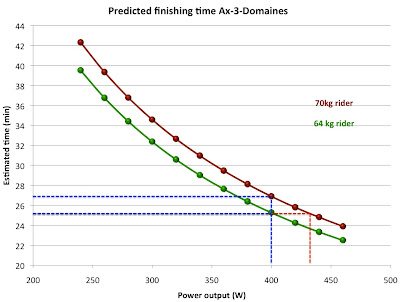
During the Tour, what I'll do ahead of each mountain stage is graphically show you the expected times, and the expected power outputs.  Then, after the stage, once the data are in, we can compare each climb to the various predictions, and describe again the insights the performances offer.

Again, I can't stress enough that this is not done with judgment of performance in mind.  It's partly because the study of the limits of performance is fascinating, and partly because we can develop informed, insightful opinions on the state of the sport by understanding the power output.  I confess, upfront, and will continue to do so as the race develops, that these are imperfect methods, involving estimates and assumptions.  Where possible, I will provide actual SRM data to validate the models (or reveal their inaccuracies), and hopefully by the time the Tour rolls into Paris in just under 3 weeks, we'll all be better for it.
It is a busy time of year for me, so I will also apologize in advance if I can't keep up with very stage of the race - these long posts obviously draw significant time away from other responsibilities, so no guarantees!  I will however guarantee that I'll share brief thoughts and the insights and analysis of others over at our Twitter and Facebook pages, so do follow us there if you would like more frequent, shorter thoughts during this 100th Tour de France.
The goal here is to establish baselines of performance and to raise flags when performance exceeds that which may be physiologically possible. Tucker explains:
The power output of course produces the time, and so the first point of analysis is to compare times from one year to the next.  If a rider in 2013 produces an ascent of Alp d'Huez that is faster than anything Pantani, Ullrich, Virenque and Armstrong were able to produce given the doping of that era, then it should be pause for concern and some suspicion.
This has been an "unpopular" concept because some people assume it to be the equivalent of guilt based on performance - if you are too fast, you must be doping.  That's not entirely true, though it would be almost patronizing to say that there isn't an element of truth in it.  The reality, as far as I'm concerned, is that in the past, doping exerted such a large effect on performance that it pushed performances beyond what is possible with normal physiology.  . .

In time, advances in training, technology and preparation may slowly erode that advantage, but within a narrow period of a few generations, the effect of the doping seen in cycling in the 90s and early 2000s was so large that I don't believe it possible to match doped performances, and so if or when it happens, some very important questions must be asked.  Certainly, in the last few years, every Grand Tour has experienced a "slowing down", and the times in the Giro, Tour and Vuelta have been, with one or two exceptions, slower than they were prior to the biological passport's introduction.  In 2011, I wrote a piece for the New York Times describing this and since then, the performances have remained slower.  Not proof of a clean sport, by any means, but an encouraging sign.
Care must always be taken to maintain a stance of innocent until proven guilty (and by extension, what constitutes criteria of guilt), however, closer attention to the metrics of quantitative performance can serve as a useful complement in efforts to manage doping in sport.