Minggu, 09 Juni 2013

The Iran Job


I saw The Iran Job on my flight back from London last week. It is a really neat documentary about US basketball player Kevin Sheppard's journey to Iran to play basketball (Sheppard also has the distinction as being capped for the US Virgin Islands football squad).

Here is an excerpt from a Washington Post article on the film:
Iranian teams offer lavish salaries to foreigners willing to play there, and every year a handful of Americans are scattered through the country’s basketball league. The idea for the film was to find an American “who would go into Iran with a lot of the same perceptions and misperceptions as a lot of us,” said Till Schauder, who wrote, produced, directed and shot it.

Sheppard, born in the U.S. Virgin Islands in 1979 — the year that Iranians staged a revolution and occupied the U.S. Embassy in Tehran — fit the bill. He said he knew little about Iran before going there.

In the film, Sheppard teaches the Iranians how to raise the level of their play and pump themselves up, and the Iranians teach him about Persian politeness and subtle ways of circumventing government oppression.

Along the way, Sheppard’s views on Iran evolve. “I had all the preconceptions that people were on camels, that they were terrorists, that they were probably making bombs,” he said in a telephone interview from the Virgin Islands, where he runs a basketball camp for disadvantaged youths.

Instead, he finds teammates who confide in him about girl troubles and refuse to let him pay for dinner. He meets women who express their frustration with state-imposed restrictions and young fans who shyly ask for his do-rag as a memento.

Sheppard said he hopes the film, expected to be released next year, will alter U.S. perceptions of Iran at a time when diplomacy is at a low. “I think that once you get an opportunity to see it, you must have a change of heart about the Iranians because you’re going to see real live people, with real lives and real struggles,” he said.

The film is full of funny moments, such as when Sheppard enlists his baffled building manager to help him find a Christmas tree, or when an elderly man selling antiques eagerly tells Sheppard that he smoked marijuana in the United States.

Schauder and his wife and co-producer, Sara Nodjoumi, who is of Iranian descent, said an Iranian government official was initially supportive but then abruptly changed his mind and told them the project was “garbage.” They were denied journalist visas, so Schauder, a German citizen, went on a tourist visa and shot with a small hand-held camera. Eventually authorities caught on, and he was barred from entering Iran. By then, he had shot most of the film.

Despite rising tensions between the United States and Iran, Sheppard said he never had a problem on either end during the two additional seasons he went on to play there. Entering Iran, “I would say, ‘Bazi [play] basketball!’ and they say, ‘Great!’ and let you go. It’s like athletes transcend political pressures. We’re entertainers; we kind of take them away from the problems.”
It is due to be out in the US soon. Check it out, highly recommended.

Kamis, 06 Juni 2013

Technology Aids in Referee Decision Making

Over at the Guardian's Political Science blog I have a commentary up extolling the use of technological aids in referee decision making. I open the piece as follows:
Writing in Nature last week, Nic Fleming argues that "the introduction of goal-line technology to football is likely to perpetrate a mass deception on television viewers." He further worries that, "It will miss a huge opportunity to educate people about the role of uncertainty in science. And it will exacerbate the approaching danger of fake computer-generated video footage."

Here I take the other side. People, especially the sports-viewing public, understand uncertainties just fine. Contrary to Fleming's concern, the opportunities that may actually be missed here include the chance to educate scientists that the public are far more sophisticated than experts generally believe, and the fact that the introduction of technological aids may actually make sports better.
Have a look at both Fleming's Nature piece and my reaction. Is there a dangerhere related to public understanding of uncertainties? I don't think so, but I welcome hearing other views.

Several people have mentioned the Collins/Evans papers on the use of the Hawkeye system in tennis and cricket. I included a link to them (thanks to a suggestion by @AliceBell), though I only agree with parts of their argument.

The parts that I agree with have to do with the central-ness of of legitimacy derived through an alignment of outcome as judged by the officials and as judged by the spectators (this is my jargon, Collins and Evans have their own). I also agree with their conclusion that such technological aids offer much in the way of positive benefits to decision making in sport.

The parts that I disagree with focus on the supposed new-ness of technologies in sport and a corresponding risk to public understanding of uncertainties. My view is much more aligned with Allenby and Sarewitz in that refereeing systems are what they call techno-human systems. The technologies of refereeing sporting events have been evolving for a long time. I would argue that the addition of the Hawkeye system -- or for that matter more, or less officials, instantaneous communication among officials, video replays, heat sensors, doping tests, timing devices, photo finish cameras, changes to the guidelines for adjudicating contingencies and so on -- represents the evolution of a techno-human system that has been under constant evolution, not something so fundamentally new.

Collins and Evans (and Fleming in Nature) worry that the results from Hawkeye (and the like) are presented to viewers without accompanying statistics on uncertainty. However, this is no different than the fact that lines calls have always been presented to viewers without accompanying statistics on uncertainty (such as the number of chair overrules in tennis or missed given goals).

The presentation of such apparently deterministic information has not prevented the public from concluding that uncertainty nonetheless remains -- at least in the context of weather forecasts where there has been a great deal of investigation of public understanding of uncertainties (e.g., here in PDF). Based on that large literature I'd think it likely that people are pretty sophisticated when it comes to sport as well, as it shares many of the same characteristics as weather forecasts (i.e., especially the fact that there are many chances to observe expert judgment and real-world outcomes).

At a minimum, those expressing concern about a danger to the public from increasingly sophisticated techniques of arbitrating sporting events should provide some empirical evidence in support of that danger. As I see it, such sophistication in adjudication simply parallels increasing sophistication in our ability to view the games. Our techno-human systems are evolving. And that is a good thing.

Senin, 03 Juni 2013

Which Way for Sunil Gulati?

I have a commentary up at Play the Game on Sunil Gulati, head of US Soccer, and his new role on the FIFA Executive Committee. Here is an excerpt to whet your interest:
Gulati, who has not commented on the alleged corruption at CONCACAF which took place while he helped govern the organization, served on the FIFA governance reform committee until his recent election to the FIFA Executive Committee. Thus he helped to develop its recommendations aimed at improving the governance of the organization. Now as a member of the FIFA Executive Committee, Gulati found himself last week in the odd position of receiving advice that he has helped to prepare.

Gulati and colleagues identified as “indispensable” several of the recommendations that the reform committee has proposed to FIFA, but which have not yet been adopted. These include a call for independent integrity checks, term limits in office and full disclosure of compensation.

Surely, as one who helped develop the “indispensable” advice, Gulati might have been expected to be a vocal champion for implementation of the proposals at last week’s FIFA Congress, right? Think again. Since joining the FIFA Executive Committee, Gulati has been almost entirely invisible on issues related to FIFA reform, and based on his actions last week, perhaps even an obstacle.
Go here to read the whole thing, and feel free to come back and comment.

Minggu, 02 Juni 2013

Wise Words from @ChangeFIFA

Kamis, 30 Mei 2013

Sunil Gulati Rejects His Own "Indispensable" Advice on FIFA Reform

Andrew Warshaw writes at InsideWorldFootBall (emphasis added):
High-ranking sources have told Insideworldfootball that a ballot was taken at Tuesday's executive committee meeting and that the result was 16-8 in favour of putting off a decision both on an upper age limit for executive committee members and/or the number of permitted terms of office.

Although there were valid and differing opinions within the executive committee over the correct way forward, all eight votes in favour of dealing straight away with the concept of statute-changing age and term restrictions are understood to have come from FIFA's European members who were said to be frustrated that no-one else supported them.
What this means, if accurate, is that Sunil Gulati, recently elected to the FIFA ExCo from CONCACAF, voted against the age limit and terms of office proposal. This is significant because up until being elected to the FIFA ExCo, Gulati was a member of the FIFA Independent Governance Committee which proposed the age and term limits.

Gulati thus rejected advice that he had proposed as "indispensable" as a member of the FIFA IGC (here in PDF).

Warshaw quotes one non-European member of the ExCo as saying the following:
 "It was the right decision," one non-European executive committee member told Insideworldfootball. "It would never have got the three-quarters majority needed and may never have therefore seen the light of day at all. At least this way we have another year to all agree on something concrete."
Given the American colloquialism, I'd wager that there is a good chance that this quote comes from Gulati. If so, then he is arguing that reform proposals should not be brought to the FIFA Congress for the simple reason that they may not succeed. This is a dubious line of argument. The Executive Committee could reintroduce such a measure next year regardless of what happens this year. Instead, Gulati is helping to torpedo reform from within. If the statement does not come from Gulati, then he still should answer why he voted against a reform that he earlier signed on to as "indispensable."

Either way, Gulati's behavior is a huge disappointment. The ExCo vote on the age and term limit reforms, and Sunil Gulati's behind-the-scenes actions at odds with his public recommendations does not suggest that he will be an active champion of reform from within. As president of US Soccer, Gulati operates without term limits. He has not yet said whether he believes they should be instituted.

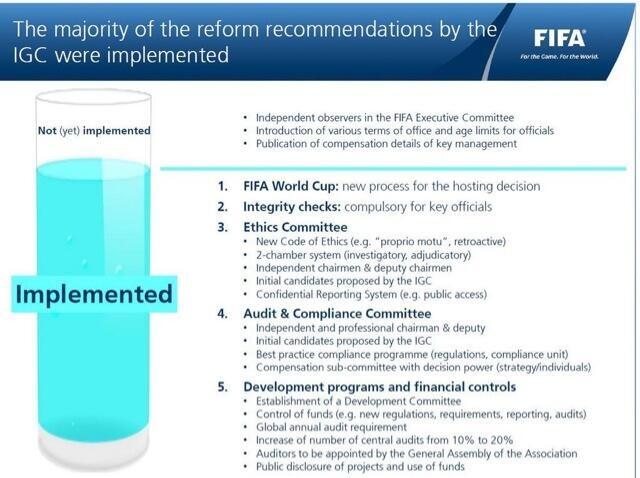
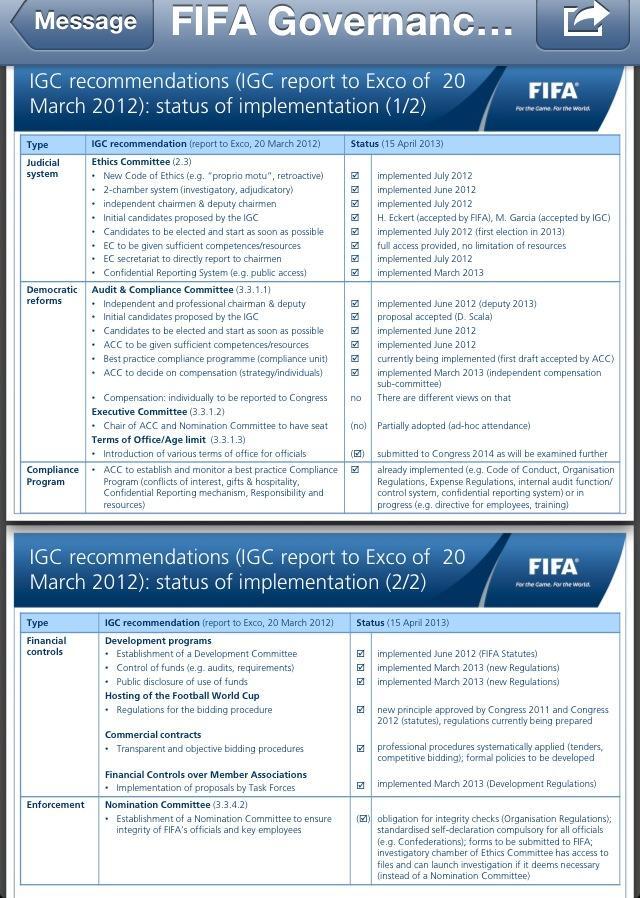
FIFA Grades Itself on Reform

Earlier today in Mauritius, FIFA President Sepp Blatter presented the following tables to illustrate how FIFA sees the completion of its reform process. Courtesy @danroan and @RobHarris.


Rabu, 29 Mei 2013

Dominico Scala on FIFA Reform and Corruption

Dominico Scala, the Chairman of FIFA's Audit and Compliance Committee, met with the media earlier today. He offered these comments on the CONCACAF Integrity Report, as reported by the New York Times:
Former FIFA vice-president Warner from Trinidad & Tobago, who was the president of CONCACAF for 21 years, and Blazer of the United States, his general secretary for most of that time, were both members of FIFA's executive committee.

Warner turned his back on football after being implicated in a bribery scandal in 2011, while Blazer has also left the game although, on a technicality, he is suspended from FIFA's executive committee until Friday.

The two men were vilified in a report commissioned by CONCACAF, the confederation responsible for soccer in North and Central America and the Caribbean, and published at their Congress in Panama in April after the examination of 5,000 documents and the testimony of 38 individuals.

"If you read the CONCACAF integrity report it does not say anything positive or polite (about them)," said Scala, a 48-year-old Swiss industrialist who is charged with enforcing new financial controls at FIFA as well as guiding the body's reform process on to the statute books.

"It's a horrible document so therefore whatever they are saying today is frankly useless and worthless because, over an extended period of time, they abused the system.

"I cannot judge on the other cases (of FIFA corruption) as I have no insights but I think it is a stretch to say now that what happened in CONCACAF happened in all the confederations.

"But here we have two individuals who behaved the way they did. Do we have other cases like this at FIFA? Maybe, I don't know, but we have to face facts; we have to be very careful of accusing everybody because we have had 10 years of accusations and allegations and suspicions."
Scala's comments raise some interesting questions, most prominently, why did it take so long for the abuse of the FIFA system to become formally recognized by FIFA? Why didn't FIFA uncover these fact previously, especially as many of the allegations were substantiated for FIFA by investigative journalists?

Also of note is Scala's apparent dismissal of the Warner/Blazer issues as not longer within the purview of FIFA:
"In the case of Jack Warner and Chuck Blazer this has far bigger implications than just (FIFA's) Ethics Committee, or the rules of the game," Scala said at a rare media briefing the day before FIFA's annual congress starts.

"There is sufficient suspicion that they have gone against the law and this will become an issue for the FBI and the IRS (Internal Revenue Service) in the case of taxation.

"So here the Ethics Committee and the world of FIFA stops - and people who have gone against the law will have to deal with the law."
FIFA's rush to move from largely ignoring the corruption within its Executive Committee to declaring the issues now to fall outside of its purview, and into the hands of US law enforcement, simply adds to the perception that FIFA is not yet fully serious about its reform agenda.

Perhaps tellingly, FIFA's official press release on Scala's press interview failed to report his remarks on Warner and Blazer. Instead FIFA emphasized Scala's defense of the now completed FIFA reform process:
“A two-year process to overhaul a global organisation like FIFA is quite ambitious, and normally corporate organisations – and I have worked for a few which are similarly complex – do not achieve this in such a limited timetable” continued Scala. “More than twenty of the recommendations for reform proposed by the IGC have been approved, but till now, this hasn’t been fully recognised or appreciated” he added.
In the interview, Scala also demonstrated another example of FIFA run-around, when asked about Sepp Blatter's salary:
[Scala] knows Blatter's salary. However, he says it's ''not my role to disclose.''

Blatter has reportedly referred questions over his earnings and bonuses to Scala.
He also hinted at problems in the allocation of FIFA development monies, but did not provide details:
Scala revealed to reporters that FIFA's finance committee had blocked projects in seven countries because of accounting concerns - though he would not identify them.
Scala's interview is welcome (and "rare" according to Andrew Warshaw) but it mainly serves to further illustrate how far FIFA has yet to go to achieve even basic standards of due diligence an transparency.